

1·
18 hours agoI mean, difficulty is relative mate. I just said I couldn’t get Snikket working (after multiple tries, too) but I’ve spun up both matrix servers. So I’d personally say it’s harder.
I mean, difficulty is relative mate. I just said I couldn’t get Snikket working (after multiple tries, too) but I’ve spun up both matrix servers. So I’d personally say it’s harder.
Part of the appeal of these services, to some, is the decentralization.
Just a heads up, I feel like the people here who say things like “snikket is easy” are knowledgeable enough to forget what being a beginner is like.
I’ve been able to get both a Synapse server and a Continuwuity server up and working before I’ve been able to get anything XMPP working, including snikket. For being the older protocol, XMPP stuff just seems to be harder to find help/tutorials for, at least in my experience so far.
Heh, I’ve actually moved away from using Google Home stuff because it’s shoving Gemini down my throat and it’s been worse in the last six months than it was a year ago.
Welcome to Lemmy! Unfortunately I can’t be of help, but if you’ll indulge me, I’m curious why you got “fed up” with using Tailscale.
The setup I have does require a domain name, yes. I DNS challenge through cloudflare at the moment to get a wildcard cert for *.domain.tld and use that for my local services, including my modem, to serve with https.
I don’t have anything to help you, other than to say you’re probably onto it being something specific about your router wanting more info from the reverse proxy. I have an actiontec modem I proxy behind nginx proxy manager and it works fine without any additional configuration, though.
What I really wanted to comment on was my surprise that everyone in a self hosting community assumed you were exposing that to the public when you absolutely did not say anything that implied it. Do none of you reverse proxy your local services? It’s wonderful!
Edited to add: actually, what cert are you using? I recently switched to a wildcard cert via DNS challenge from Let’s Encrypt and everything has worked better since then.
Outsiders accessing all the services via tailscale is not an acceptable solution for me. Let’s say for sake of my goal that one service is a blog that I want anyone to be able to reach.
nslookup sub.domain.tld AGH.IP.Address
This should respond authoritative with the IP you need to access NPM’s VIP IP address.
That returns a non-authoritive answer only, but the address is Unraid.IP.Address (which NPM is running on). Here’s the AGH rewrite I’m trying:
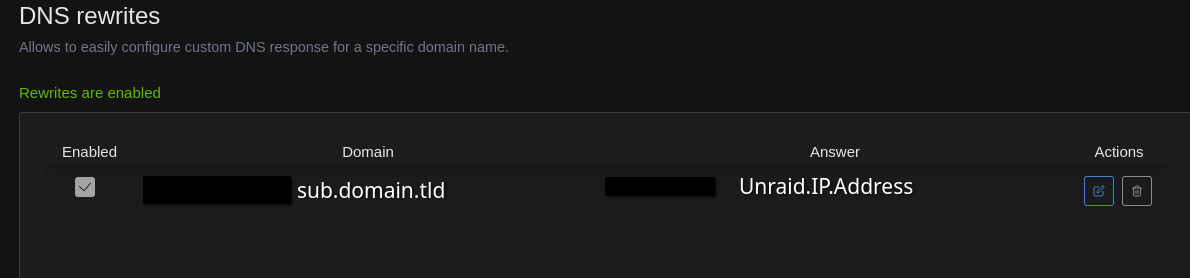
Here is the result of the curl:
21:55:55.862001 [0-x] * [READ] client_reset, clear readers
21:55:55.863057 [0-0] * Host sub.domain.tld:443 was resolved.
21:55:55.863116 [0-0] * IPv6: (none)
21:55:55.863146 [0-0] * IPv4: Unraid.IP.Address
21:55:55.863183 [0-0] * [HTTPS-CONNECT] adding wanted h2
21:55:55.863234 [0-0] * [HTTPS-CONNECT] added
21:55:55.863274 [0-0] * [HTTPS-CONNECT] connect, init
21:55:55.863330 [0-0] *   Trying Unraid.IP.Address:443...
21:55:55.863396 [0-0] * [HTTPS-CONNECT] connect -> 0, done=0
21:55:55.863447 [0-0] * [HTTPS-CONNECT] Curl_conn_connect(block=0) -> 0, done=0
21:55:55.863518 [0-0] * [HTTPS-CONNECT] adjust_pollset -> 0, 1 socks
21:55:55.863576 [0-0] * [HTTPS-CONNECT] connect -> 0, done=0
21:55:55.863625 [0-0] * [HTTPS-CONNECT] Curl_conn_connect(block=0) -> 0, done=0
21:55:55.863697 [0-0] * [HTTPS-CONNECT] adjust_pollset -> 0, 1 socks
21:55:55.863792 [0-0] * connect to Unraid.IP.Address port 443 from My.PC.IP.Address port 57824 failed: Connection refused
21:55:55.863894 [0-0] * Failed to connect to sub.domain.tld port 443 after 1 ms: Could not connect to server
21:55:55.863985 [0-0] * [HTTPS-CONNECT] connect, all attempts failed
21:55:55.864043 [0-0] * [HTTPS-CONNECT] connect -> 7, done=0
21:55:55.864094 [0-0] * [HTTPS-CONNECT] Curl_conn_connect(block=0) -> 7, done=0
21:55:55.864163 [0-0] * [HTTPS-CONNECT] Curl_conn_connect(), filter returned 7
21:55:55.864231 [0-0] * [WRITE] [OUT] done
21:55:55.864268 [0-0] * closing connection #0
curl: (7) Failed to connect to sub.domain.tld port 443 after 1 ms: Could not connect to server
I am willing to try almost anything! What are you thinking, like route them through a VPN or something?
Would this method allow other people to connect to one of the services? Let’s say, for sake of example, it’s a blog that I want people to be able to access, but I also want to access from within my own network at the same FQDN that strangers on the internet do.
I try to always follow 3-2-1 backups!
Thanks for the detailed response! Those specs are very close to what I ended up getting a Synapse server running on. I would like to try getting Continuwuity going next and compare.
Very interesting stuff, thanks!
I am not saying it’s exactly the same but that does sound similar to what I am gonna try out. Main my first successful spin up I just have everything in a frankly small VM running on an ssd, but next I’m going to play around with mapping the crucial stuff on that ssd but putting media on my 8TB platter.
Could you explain what makes an S3 bucket better suited than the default storage scheme? No pressure if not, you’ve already been helpful!
Cheers, I appreciate you taking the time to write it out. I’m definitely no pro but I’m on my way to learning this stuff. I’ve heard of S3 but never used it. Maybe I’m oversimplifying, but it just sounds like dedicated cloud storage, maybe that has been optimized for efficiency?
Where I’m at right now is considering using my own storage. I have a lot of platter space, which yes yes I know, that is far from ideal but I was going to try it out and see just how bad the performance was. I’m aiming to host for a pretty small community (>50, probably even >25).
This is unrelated to my question.
Could you expound on what you mean, or how to go about it? Links to documentation would be appreciated.
Welp, I got Synapse deployed before Continuwuity lol
Here are a ton of royalty free podcast themed images: https://unsplash.com/s/photos/Podcast